Witches and Werewolves.
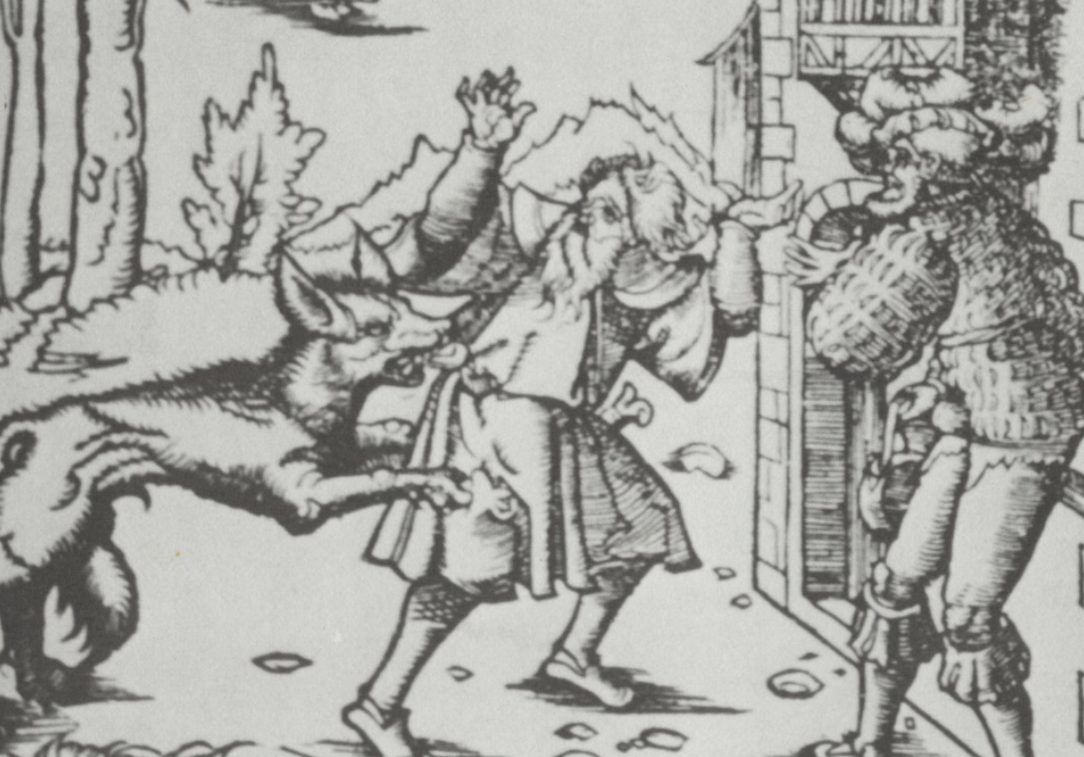
Wolf from Johannes Geiler von Kaisersberg. Die Emeis , 1517. C - The only illustration of a werewolf to appear in a witchcraft text in the sixteenth century.
Last year, for Halloween, I brought you all a tale of vampires, football, and spooky punctuation, and I thought I’d once again bring you a spooky historical piece. This year we’re going to do a deep dive into witches and werewolves, and I’ll introduce you to the cases of two sixteenth century werewolves.
Did you know that, much like the famous witch trials of Europe and Salem that I’m sure you have heard of, there were a similar type of spooky trials that took place between the fifteenth and eighteenth centuries - the werewolf trials…
Imagine for a moment you’re a farmer in the Middle Ages living in a small village in France. The forest borders the edge of your farm on which you grow wheat and barley, raise sheep for wool, pigs for meat, and cows for the milk that you turn into cheese, perhaps a delicious Comté or Roquefort. Each day you oversee the farm, and the work of your peasant labourers, and keep a watchful eye over the land. But as night falls, you head inside with just a few candles and a fire burning to light your surroundings, as outside the wind blows, and distant howls begin. One night, as you try to sleep, you hear that howl just slightly too nearby and run through the pitch-black farm, hoping to scare off whatever was there, but it has already gone and taken one of your pigs with it. The peasant you pay to guard your animals through the night sits cowering in the corner, their clothes ripped and with cuts to their side and arm. Two wolves have snuck into your farm and stalked through the space to find their prey for the night before disappearing back into the forest, their howls once again a distant noise.
While today you are unlikely to have an encounter with a wolf in Europe or the UK, they were historically much more prevalent and represented a serious threat to livestock and occasionally humans - that threat is why you will no longer find them in the UK, having been hunted to extinction to protect humans and livestock. These encounters did, however, leave a mark on populations, creating a sense of fear and anxiety. While human attacks were not incredibly common, when one did happen, the victim would be at risk of rabies - an illness that can take some time to appear. But when it does, it can change a person in front of your eyes into someone who is hallucinating and aggressive, scared of water, highly agitated, salivating, and unable to sleep before finally succumbing to the illness. Whilst now, rabies is often preventable, it most certainly was not in the Middle Ages, and would have been terrifying - and perhaps reminiscent of how we might now think of a human-to-werewolf transition.
It was in that context, and amid a long history of wolf superstitions, shapeshifting stories, and fears of sorcery across Europe, that we reach Switzerland in the 1400s . It was here, in Valais, that the first witch trials occurred. A systematic campaign that eventually spread across Europe, it also included werewolf trials. At the time, witchcraft authorities spent quite a bit of time thinking about the link between witches and wolves - could the witches be werewolves themselves? Did they change other people into werewolves? Did they enchant wolves directly and use them to attack people and/or other animals? Did they enchant the wolves and ride them around like a horse (numerous people were certainly sentenced and burnt for this crime)? This lycanthropy, or ability to shape shift into a wolf or human/wolf hybrid was often seen as separate but linked to witchcraft - the lycanthropy itself was sometimes described as a delusion, or trance brought on by the Devil himself, and in this way was likened to the trances entered into by a witch - the famous witch hunting guide the Malleus Maleficarum includes stories of wolf like transformations and sinful delusions that accompany them.
For a few years in the mid-1450s a number of women were tried and killed as witches whose crimes involved wolves - these primarily involved accusations that the witch in question had been seen riding a wolf on the way to do her dastardly witchy things like raising storms, and causing avalanches. But then, for about twenty years there cease to be recorded instances of trials involving witches enchanting wolves - perhaps there ceased to be avalanches that needed explanation. These trials were noted in the book De Lamiis (1489–1669) which was reprinted with forty three editions across 180 years (more than the better known Malleus Maleficarum), and whose long history shows a changing set of ideas of witchy beliefs and superstitions - for example the fluctuation of trials involving wolves. However discussions of witches and wolves were not limited to just these two books with plenty of other fifteenth century texts making the connection - though there was not always consistency when answering the question ‘can transmutation into a werewolf really happen’ .
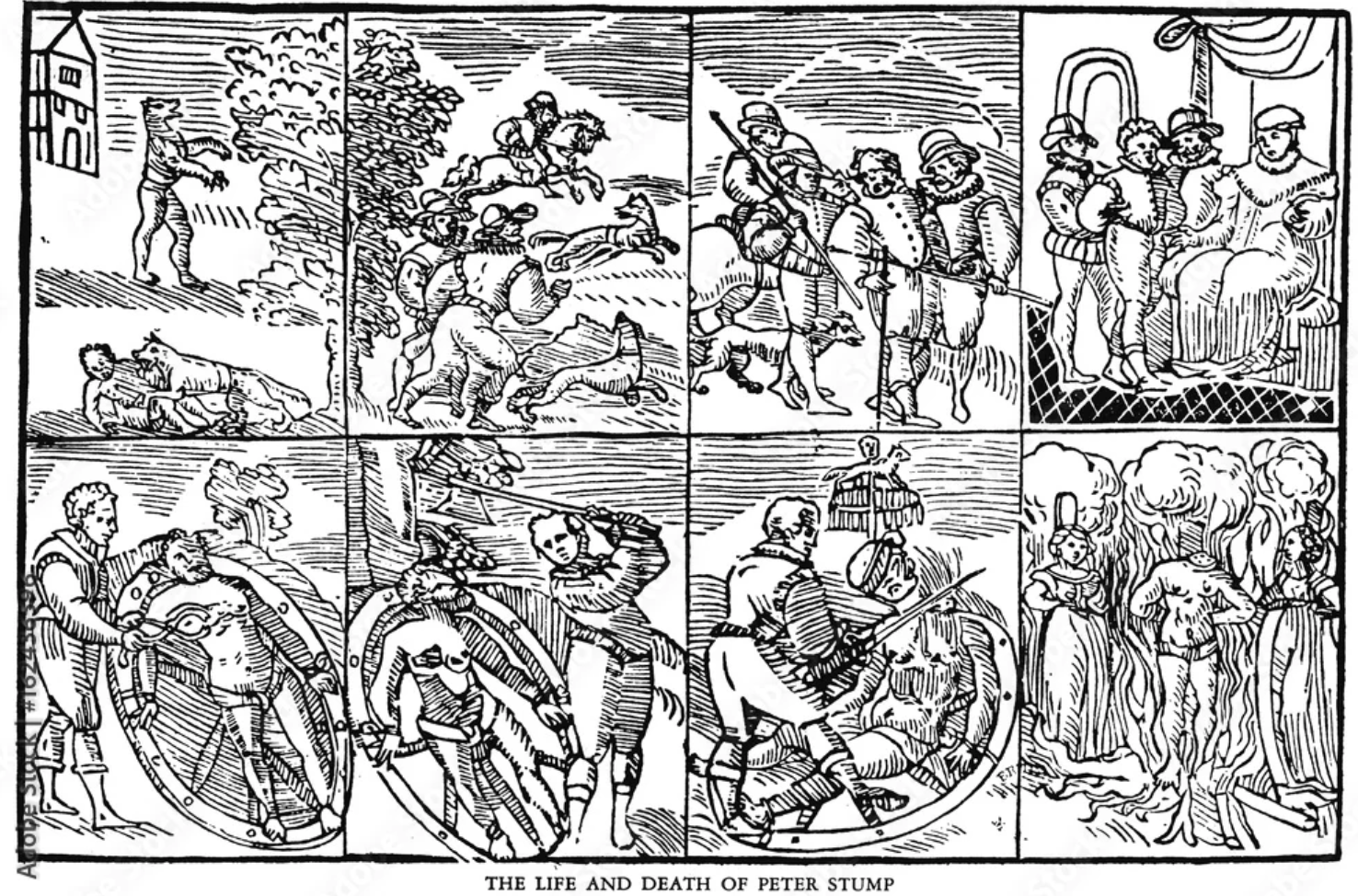
Peter Stubbe
Whether or not it could happen, people were certainly tried and killed for the crime. One of the most notorious of these was Peter Stubbe (also spelled Stumpp or Stump), executed in 1589. He was tried in Cologne for a range of acts including several murders, incest with his child, keeping several women as ‘wives’, cannibalism, and lycanthropy. For years, the area of Bedburg had lived in fear with 14 children and two pregnant women allegedly murdered in the area, and the people began to blame the monster in the woods. What we know about Peter was that he was a local landowner, widowed with a son that also died, who lived with his daughter. He had a girlfriend, a beautiful local woman, he was described as being friendly and charasmatic, and he was disabled missing his left hand, though it’s unclear how or why that was the case. One afternoon a unnamed local girl was on the edge of the forest and saw the monster of the woods. A group of locals storm through the trees after the werewolf, find him and allegedly cut off his left paw. Shortly afterwards a connection is made to Peter someone who is missing his left hand. The villagers become convinced that Peter must be the werewolf, and must be responsible for the string of murders that have happened in the area of the years. They arrest him, and interrogate him using extremely violent methods, and perhaps unsurprisingly after several days of torture he confesses to being a werewolf; to having used dark magic for many years; being responsible for his son’s death; for being in possession of a magic belt, a gift from the devil, that allows him to turn into a werewolf whenever he wants to; he confesses to a string of murders, and to crimes against his daughter. His daughter and girlfriend are also arrested and interrogated for related witchcraft and wolfy crimes - the girlfriend is a demon in disguise, and his wealth and charisma must surely be the result of black magic as it was too difficult to comprehend a disabled man being successful and dating the hot woman in the village. At trial, the magic belt was never found and produced, the left paw of the ‘werewolf’ was never found and produced, there was ableism throughout and disbelief that he could have achieved what he had without witchcraft, and through in an undercurrent of religious fervour and Catholic/Protestant issues that were raging at the time it’s probably no surprise to learn that Peter, the Werewolf of Bedburg, his daughter and girlfriend were horrifically executed on 31 October 1589. Despite not being convicted of witchcraft, later works on the subject included his case and he was often labelled as such - again showing the intermingling of ideas about the two different topics.
Gilles Garnier
Gilles Garnier lived in sixteenth century France, a hermit that at the end of his life became known as "The Werewolf of Dole". He lived in a forest north of Dole, a recluse on the edges of society. Despite being a hermit he met a woman and they married, but shortly after the weather turned and the Franche-Comté region experienced a famine and he began to wander the surrounding area looking for food to scavenge to keep them both
going, becoming progressively weaker and presumably more desperate. At this point however, things take a turn and Garnier, allegedly, takes the life of a young child, eating some of the flesh before taking some home for his wife to cook for them both. A second attack took place shortly after with it being alleged that he used his hands and teeth to kill another child, though the villagers supposedly chased him away before he could eat the child and because he was in his wolf form they could not identify him as Garnier. A third attack took place with the child being strangled, eaten, and dismembered with parts being removed. Then another week goes by and a fourth attack takes place with a child dragged into the woods. This time, the villagers were alerted by screams and ran to the woods and claimed they saw Garnier, but in his human form. As with the case of Stubbe, there is an element of religion with this case too - in at least one of the attacks Garnier was accused of eating the meat of his victim on a Friday, which goes against typical Catholic practice (where you abstain from meat on a Friday) - particularly at the time. It is unclear how he was arrested - whether it was at the time of the final attack by the citizens, or a little later by officials. Following his arrest, Garnier was interrogated, and as with Stubbe this interrogation featured torture, specifically use of the rack. It is perhaps no surprise then that Garnier confessed to the attacks and an intention to eat all of his victims - a course of action he said he was lead towards by an apparition he met in the woods that claimed it could help him by providing a salve that would allow Garnier to transform into a wolf which Garnier thought would help him find food for himself and his wife. He confessed that when he saw his first victim he was so hungry that he gave in . That he met an apparition or demon in the woods and was seduced by them fits in well alongside the thinking of witchcraft and how the devil or demons might interact with a witch. Fifty witnesses testified against him at the trial, though some of those testimonies were along the lines of ‘I saw a wolf in the woods, and a bit later I saw him, therefore must be the same’, and despite the stories that he, on several occasions, took body parts back to his house for his wife to cook, no signs of human remains were found at their home. In January 1573 he was found guilty of both lycanthropy and witchcraft, and was executed quickly after.
Eventually, belief in werewolves and witches and the moral panic they created across the continent began to die out.- albeit slowly - there were still reported cases of witches enchanting wolves in 1706 and 1707. During the werewolf panic numerous people either lost their lives, were tortured, or were banished following accusations of lycanthropy, or wolf-based dark magic. Perhaps, much like the witch trials where often the outcasts were suspected, we can see something similar here. In the case of Stubbe we have a combination of religious fighting and ableism, and in Garnier a hermit living on the edges of society, someone different and other. Other cases involved those seeking confessions, often through torture of those with mental illnesses (like clinical lycanthropy where you believe you can turn into a wolf), hallucinations from ergot or other plant toxins, or physical conditions like hypertrichosis. In the two cases I’ve introduced you to here, they may well have found the right culprit, the convicted pair may have been the murderers sought, perhaps using the excuse of being a werewolf as a way to distance themselves from their crimes. But it’s also possible that they were outcasts, scapegoated by society, they may have been mentally ill (particularly in the case of Garnier), or confessing to horrific crimes simply to stop torture, crimes that may have actually been carried out by actual animal predators. What I think we can probably say with some certainty however are that they were likely not werewolves.
‘Til the next blog post - I’m off to watch An American Werewolf in London now.
Further reading if you want to know more:
If you enjoyed today’s blog, or other content you’ve read on my site please consider dropping me a tip on ko.fi - this will help keep me in books, keep me able to travel to sites I can write about, and just keep this site running.
