Review: Women & Gardens.
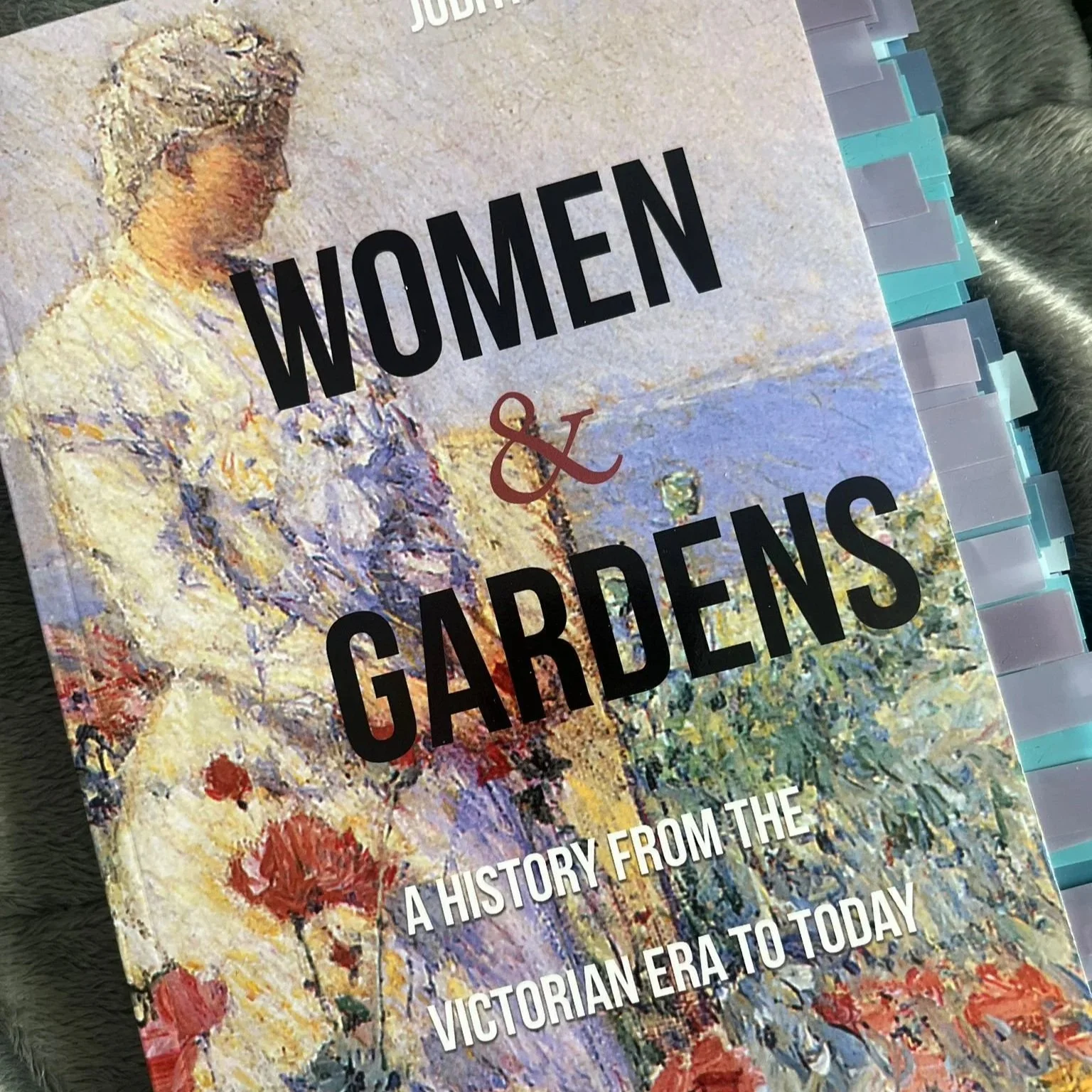
I was recently made aware of a book that came out in 2025, Women & Gardens: A History from the Victorian Era to Today by Judith M. Taylor, which I dutifully purchased as it obviously fits so well with my research area. Having just finished An Almost Impossible Thing (about which I will also write some of my thoughts in a later post), I moved swiftly on to Women & Gardens to see was Taylor had in store for me.
The book came about in a slightly different way to what you might normally expect, with Taylor drawing on an outline completed by Susan Groag Bell before her death, following an approach by one of Bell’s colleagues who asked her to take charge of the project. I’ve only read one piece of Bell’s work at the time of writing this blog, an article from 1990 (‘Women Create Gardens in Male Landscapes: A Revisionist Approach to Eighteenth-Century English Garden History’, Feminist Studies, 16.3 (1990), pp. 471 - 491) which I really enjoyed. In fact, the article seems very much to me to be the basis of chapter two in the book, so I was rather surprised to see it go uncredited.
In fact, the lack of scholarly citing is a bit of a theme throughout the book with Taylor making wild sweeping statements with little to back it up ‘women were chattels, given as prizes to victors in battle, if sold into slavery if their armies lost, with no control over their own destiny. They were often toys and playthings. Girls could not marry anyone they pleased. They had to marry a man chosen by their parents, usually the father, to promote tribal, business, or dynastic ends.’ (p.10). It’s unclear if this description is supposed to relate to Victorian women, or if it’s a generic sweeping statement about women at various points in time across various geographical locations, but it’s certainly quite the assertion. In the same vein as lack of scholarly citing is that there is just an issue with citing in general, with some of the endnotes being frankly wild - incorrectly placed endnotes, endnotes that are in the text but don’t actually exist when you go to check them, endnotes that probably should be there to explain where information is from but they just aren’t…I certainly wondered several times if the book needed an extra set of eyes during the editing process.
A section titled ‘Victorian Prudery’ made me chuckle - I enjoy this continued sense that all Victorians were prudish and awkward about sex - something historian Fern Riddell would certainly have something to say about. If you’d like to challenge assumptions you hold on the matter, I’d recommend reading her Victorian Guide to Sex. Getting less a chuckle, and more of an eyebrow raise, was when the author stated her aims for the book: ‘I would like to explore the way in which the leisured women finally separated themselves from being a faceless mass of simpering misses with muzzy bird brains good only for reproduction and become individual actors capable of contributing to previously solely masculine fields’ (p. 8).
Another slightly frustrating quirk of the book is Taylor’s writing style, where statements are made in sentences seemingly unconnected to the following one. Discussing Celia Fiennes’ descriptions of gardens in England, Taylor tells us, ‘One of the statues she saw indicates that women of the lower classes continued to earn their living as gardeners. Here is Celia Fiennes’s description of the garden of the Duke of Bedford at Woburn, “the gardens are fine, there is a large bowling green with 8 arbours kept cut neatly, and seates in each, there is a seate up in a high tree that ascends from the green 50 steps, that commands the whole parke round to see the deer hunted, as also a large prospect of the country”’ (pp. 21 - 22). What was the statue of?! Did it depict female gardeners, or were female gardeners tending to it?! Where was it?! We’ll never know. Another small gripe was a paragraph on Charles Evelyn’s The Lady’s Recreation that appears, virtually identically, twice and only 17 pages apart.
I enjoyed the descriptions of nature and the garden as a place of healing, and the discussion of the disruption to the place of women at the heart of their family and community’s health as the knowledge connected to medicine was formalised, regulated and taken over by men, whilst being closed off to women. As that happened, there was a loss in certain types of traditional knowledge, wherein, as the traditional guardians of their family and wider communities’ health, women knew the healing properties of plants. I was surprised to not see a reference to Elizabeth Garrett Anderson in this section as an example of a woman breaking down that barrier, as those in the horticultural world break down theirs, but try as I might to find EGA everywhere, it can’t always happen! I also enjoyed a section on forgotten contributions of women to medical science, which has definitely sparked ideas for future potential blogs.
I picked up the book, naturally, based on the title and the promise of the Victorian Era to today. Despite stating that the book would look at a period, ‘most particularly over the last 150 years. There will be brief references to earlier epochs to provide some background, quite a lot of the early part of the book sits outside of this time period. The background is, however, interesting and throughout the book you are introduced to a range of interesting women (including the Ladies of Llangollen who will feature in a future blog) - but don’t go into the book expecting a wall-to-wall exclusively Victorian to modern times British deep dive. That is not necessarily an issue for the reader who just wants to learn, however briefly, about women and their gardens at a more general level. Whilst I didn’t love the generally chaotic nature of the dictionary-style profiles that provided often very brief introductions, and after page after page of them left me a little disoriented, I did enjoy that in these sections, the outlined individual women and institutions, etc. didn’t just stick to Britain (I think when something is pitched as Victorian, I automatically assume Britain and maybe the colonies). Instead, you hear about individuals, gardens, and institutions from Britain, the US, Canada, India, China, and continental Europe, though the focus is primarily on the first two. It gives the reader a wide, if not deep, understanding of a range of characters who all engaged with their gardens. As someone who is super focused on the long 19thC in South East England it was refreshing to hear about entirely new women. I particularly enjoyed reading about a Chinese rose breeder I hadn’t come across before - Jiang En-tian (1908-1975), and am really keen to know more.
My view: Would I recommend? I don’t think I would necessarily recommend the book as a cover-to-cover read. Nor would I necessarily recommend it if you’re looking for a deeper level of understanding of the topic - I particularly found the lack of references to source material frustrating. The general style of writing was also rather frustrating - sentences that are short and stilted or that lead nowhere, setting up what you think will be the next paragraph only for it to pivot to something entirely different, or slightly savage and unnecessary commentary on the women chosen for entries, ‘She was a tall and slightly gaunt woman, hardly seductive in any shape or form’.
If you enjoyed today’s blog, or other content you’ve read on my site, please consider dropping me a tip on ko.fi - this will help keep me in books, keep me able to travel to sites I can write about, and keep this site running.
